

Last updated: January 2, 2026
TL;DR
Amazon does not offer a competitor price match or a universal post‑purchase price adjustment. This comes straight from Amazon’s help page: Price Matching — Amazon Customer Service.
The only formal “match‑like” promise is the Pre‑order Price Guarantee for select items ordered before release (Amazon will charge you the lowest price between order and release). See Pre‑order Price Guarantee.
If a price drops after you buy, real‑world options are: return & repurchase (most reliable) or ask Customer Service for a goodwill credit (case‑by‑case). You can also report lower prices via “Tell us about a lower price” to influence future pricing.
As of 2026, some competitors still publish price‑match policies (e.g., Best Buy), while others have scaled back (Target ended competitor price matching on July 28, 2026). See Best Buy and coverage from Business Insider and Axios.
Want it handled for you? Task Monkey (our Chrome extension) scans your Amazon orders, flags price drops within return windows, and drafts polite messages to agents to request a credit or guide a fast return.
Why this guide exists (and what “price match” actually means at Amazon)
In classic retail, “price match” means a store publicly promises to match an identical item’s lower price found at a qualifying competitor. Best Buy’s Price Match Guarantee is a textbook example and even lists which competitors qualify (including Amazon) in its qualified competitors.
Amazon, however, operates a different model. Per its official help page, Amazon doesn’t offer price matching. Instead, Amazon claims it is constantly comparing and adjusting its own prices to stay competitive across its vast catalog (Amazon — Price Matching; see also Amazon’s explanation of how it approaches pricing on About Amazon).
That core difference explains why searches like “does Amazon price match?,” “will Amazon price match,” or “can Amazon price match” tend to be dead ends on the policy side. But it doesn’t mean you have no recourse when a price drops after you buy. The rest of this guide shows what Amazon does honor, how to recover savings, and where competitor policies still matter.
Price match vs. price adjustment vs. pre‑order guarantee
When people ask “how does Amazon price match?” they’re often mixing up three different ideas:
Competitor price match — Matching a rival’s lower price for the same item. Amazon does not do this (official help).
Post‑purchase price adjustment — Refunding the difference if the price drops after you buy. Amazon does not publish a universal adjustment policy. Some agents sometimes grant courtesy credits, but that’s discretionary and inconsistent.
Pre‑order Price Guarantee — For specific unreleased items, Amazon will charge you the lowest price between order and release (policy).
Historically, rumors of an “Amazon 30‑day price guarantee” circulate every holiday season. Today, there is no broad 30‑day price match or adjustment policy at Amazon. If you see a lower price after purchase, the practical paths are below.
What to do when the price drops after you buy
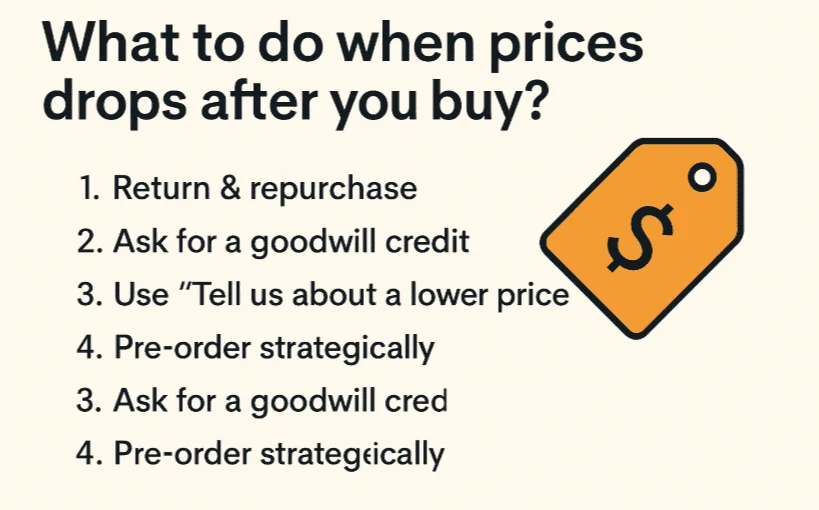
Return & repurchase (most reliable). If an item is still within the return window and a lower price appears, place a new order at the lower price and return the original (unopened when possible). This is the approach many seasoned Amazon shoppers take because it uses Amazon’s standard returns system rather than a non‑existent price‑match policy. Media outlets like The Verge have noted this as the de‑facto workaround.
Ask for a goodwill credit. Agents sometimes grant small credits when the difference is modest, inventory is stable, or the request is within a short time after delivery. It’s not guaranteed and depends on timing, category, and who you reach. (See the scripts and step‑by‑steps in the section below.)
Use “Tell us about a lower price”. On some product pages, you’ll find a link to report a lower price you saw elsewhere or on Amazon at a different time. This doesn’t trigger a discount for your order, but it feeds price evaluation signals (Amazon help).
Pre‑order strategically. When a listing shows the Pre‑order Price Guarantee, order early and let the policy do the work—the final charge will be the lowest price between order and release (policy).
Want fewer tabs?Task Monkey scans your Amazon orders for price drops, tracks return deadlines, and generates polite, high‑success outreach that reflects what we've learned from thousands of support chats across frugal and personal‑finance communities. It's designed for consumers (not sellers), and we've built it so you don't have to share your Amazon password.
Prime Day, Black Friday & other event pricing
Two of the most common questions we see are “does Amazon price match Prime Day?” and “Amazon price match Black Friday?” The answer in both cases is that Amazon won’t match those event prices after purchase. Your best bet is to return & repurchase if you’re in the window, or ask for a goodwill credit when the gap is small. For deeper, scenario‑specific advice, see our Black Friday guide.
How other retailers think about price matching (and why it still matters)
Even though Amazon doesn’t match competitors, competitor policies still affect your choices. If Walmart, Target, Best Buy, Costco, Home Depot, Lowe’s, or Newegg has the lower price, you may want to buy there—especially if that store will honor future price drops during a published window.
For instance, Best Buy maintains a publicly posted guarantee and typically extends a broader match window around the holidays (policy). In 2026, Target announced it would end competitor price matching and limit matching to its own prices instead, aligning its stance closer to Walmart and Amazon; see coverage from Business Insider and Axios.
We maintain retailer‑specific explainers so you can decide where to buy:
If you’re specifically searching for “bestbuy amazon price match,” remember: Best Buy may match an identical item sold by a list of competitors (including Amazon) when certain conditions are met; see the qualified competitors and the full guarantee.
Why Amazon’s marketplace makes “price matching” tricky
Amazon is not a single store; it’s a marketplace with millions of third‑party (3P) sellers alongside Amazon Retail. Multiple offers for the same listing can exist at the same time, each with different shipping speeds, return policies, and prices. The “Buy Box” simply surfaces the offer Amazon’s systems believe provides the best value. Amazon publicly explains that it works to keep prices competitive across the site and that independent sellers set their own prices (About Amazon — pricing).
That structure is the main reason there’s no simple how does Amazon price match button. “Matching” which offer—Amazon Retail’s, or a specific 3P seller’s? What if a coupon or a temporary Lightning Deal drops the price for two hours, then disappears? Amazon’s solution is to let prices vary and let shoppers choose the best offer at the moment, rather than publish a guarantee it would need to honor retroactively.
Edge cases: who sold it, coupons, and membership pricing
Who sold/fulfilled the item matters. A refund expectation that might feel intuitive for items “Sold by Amazon.com” is even less likely for a third‑party seller. Amazon facilitates the transaction but does not set 3P prices. Many “does Amazon price match?” frustrations come from orders that were actually fulfilled by a marketplace seller.
Coupons and timed deals are not “prices.” A clipped coupon or a Lightning Deal is a promotional mechanism layered on top of the base price. Even retailers that do offer price matching often exclude coupons, promo codes, bundle offers, and limited‑time events for exactly this reason.
Membership or app‑only pricing is usually excluded elsewhere. When you read a competitor policy (Best Buy, Costco, etc.), there’s almost always language excluding prices that require a membership, a special app, or marketplace sellers. That’s why the cleanest comparison is usually Amazon Retail vs. another retailer’s first‑party listing. (See Best Buy’s list of qualified competitors.)
What actually works (patterns from our community)
Across thousands of chats we’ve studied while building Task Monkey, three patterns repeat:
Small drops get small credits. When the gap is just a few dollars and you’re within days of delivery, agents are more likely to offer a courtesy credit. It helps when you’re polite, concise, and demonstrate you understand Amazon doesn’t formally price match.
Big drops favor returns. If an item falls $20–$200, the predictable path is to place a new order at the lower price and return the original unopened. It’s cleaner operationally for Amazon than making manual adjustments.
Timing beats arguing policy. The sooner you act—ideally before your return window closes—the better your options. Waiting to “see if it goes lower” often leaves you outside the return window with no courtesy options left.
We designed Task Monkey precisely for these moments: it flags price drops quickly and drafts gentle, on‑policy language so you can either request a small credit or pivot to a return without copying scripts between tabs.
Two short scripts you can copy‑paste
If you just need something fast, here are two scripts you can copy‑paste:
Polite goodwill credit request
“Hi! I bought [item name] (order [#]) and noticed the price is now lower at Amazon. I know Amazon doesn’t do a formal price match, but if there’s any goodwill credit you can offer, I’d really appreciate it. If not, no worries—I can return and repurchase. Thank you!”
Return & repurchase nudge
“Hi! I’m within the return window for [item], but I see it’s now cheaper. Should I return and reorder, or is there any small courtesy credit available to save a return? Thanks either way!”
Myth‑busting and gotchas
“Amazon price match within 30 days.” There’s no such published policy at Amazon today. Some retailers use 14–30 day windows, which fuels the myth.
“Agents must match if it’s Amazon vs. Amazon.” No. There’s no guarantee Amazon will “price match itself.” Multiple Amazon or seller offers can coexist.
“Pre‑order = post‑purchase adjustment.” The Pre‑order Price Guarantee only applies from order to release for qualifying listings. It doesn’t cover normal pricing after release.
“Reporting a lower price gets me a refund.” The Tell us about a lower price link is feedback, not a ticket for an immediate adjustment.
Exact searches matter. People type “does amazon price match microcenter” (one word) and “does Amazon price match Micro Center” (two words). The answer is the same: Amazon won’t match Micro Center.
FAQ — Real questions people actually type
Does Amazon price match?
No. Amazon states it does not offer price matching because it constantly compares prices across competitors and adjusts its own accordingly. See the official policy: Price Matching.
Will Amazon price match?
“Will Amazon price match” is a very common query, but the answer is still no for competitor matches and no for a universal post‑purchase adjustment. Try a goodwill credit or return & repurchase.
Does Amazon price match?
Some people include a question mark—“does Amazon price match?” or “amazon price match?”—but the outcome is the same: Amazon doesn’t price match.
Can Amazon price match?
No public mechanism exists to force a match. Individual agents can sometimes apply goodwill credits, but that’s discretionary, not policy.
Do Amazon price match?
This is the same question in different words. The answer is still no for competitor matching and no universal adjustment program.
How does Amazon price match?
Strictly speaking, it doesn’t. Amazon uses dynamic pricing and a large 3P marketplace to keep offers competitive instead of matching on request. See About Amazon — pricing.
Does Amazon price match Micro Center?
No. Amazon does not match Micro Center (or any competitor). If you want the lower price on Amazon, use a return & repurchase or request a small courtesy credit.
BestBuy Amazon price match
If you’re trying to get “bestbuy amazon price match,” note that the store doing the matching is Best Buy. Best Buy will often match an identical item sold by a list of competitors, including Amazon, subject to exclusions and proof. See qualified competitors and the guarantee.
Barnes and Noble Amazon price match
Amazon won’t match Barnes & Noble. If B&N is cheaper and timing matters, consider buying there; if Amazon drops its price later, use returns/repurchases or ask for a goodwill adjustment on Amazon.
Related Articles in This Topic
Does Amazon Price Match Black Friday? — Holiday Deals Explained |
Does Amazon Price Match Its Own Prices? — Match vs Adjustment |